
USDOT Decal Requirements: Placement, Letter Size & Examples
Reviewed October 11, 2026
Ordering USDOT decals should start with the information your vehicle needs to display. The available space on the door is only part of the decision. The carrier name, number, placement, and readability all matter.
This guide explains the general federal marking requirements, shows sample layouts, and walks through the design decisions to make before ordering lettering for your truck, van, or other commercial vehicle.
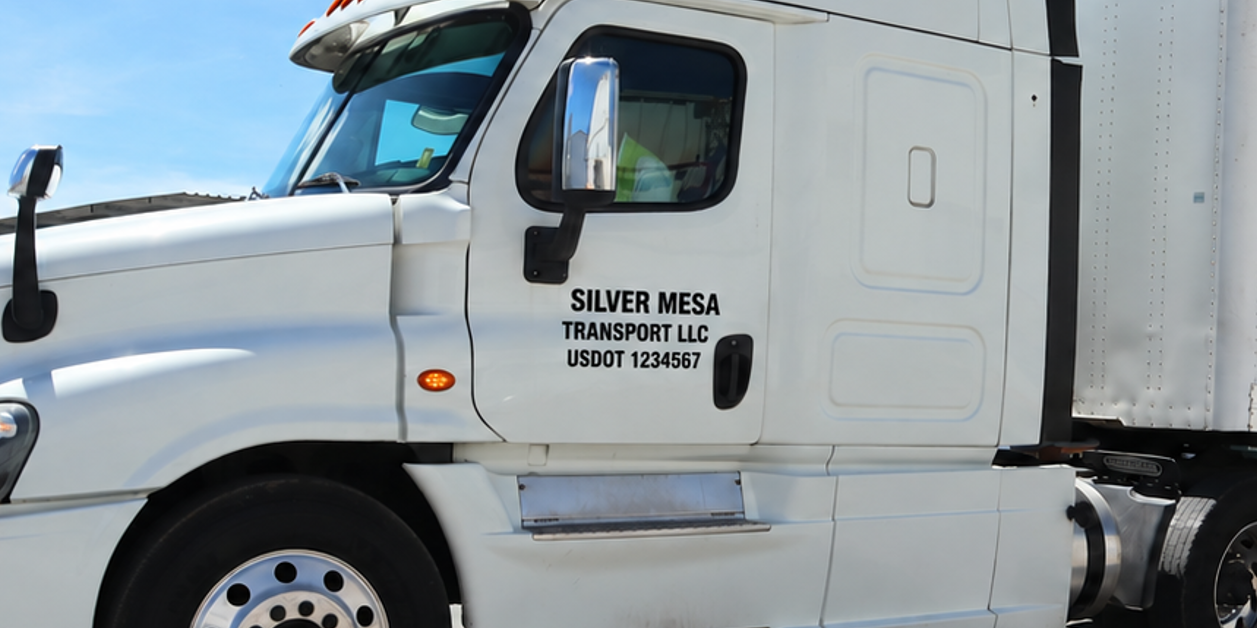
USDOT decal requirements at a glance
For a self-propelled commercial motor vehicle subject to the federal marking rule, display the operating carrier’s registered legal name or a single registered trade name and its identification number with USDOT before the digits.
Put the required markings on both sides, use sharply contrasting colors, and keep them readable from 50 feet in daylight while the vehicle is stationary.
FMCSA summarizes these requirements in its Motor Carrier Safety Planner. The detailed rule is 49 CFR § 390.21T.
Does your vehicle need USDOT markings?
A business logo alone does not determine whether a vehicle falls under federal motor carrier rules. For interstate transportation of property or passengers, the federal commercial motor vehicle definition includes these triggers:
- Weight: A vehicle or combination with a rating or actual weight of 10,001 pounds or more, using the greater applicable value.
- Paid passenger transportation: Designed or used to carry more than eight people, including the driver, for compensation.
- Unpaid passenger transportation: Designed or used to carry more than 15 people, including the driver.
- Hazardous materials: Transporting a quantity that requires placarding.
See 49 CFR § 390.5T for the definition. Exceptions and operation-specific rules can affect applicability.
Staying within one state does not automatically make transportation intrastate. A local trip can be part of a shipment originating or ending outside that state.
States can also impose USDOT registration requirements on intrastate operators. FMCSA lists Nevada among those states. Check the FMCSA registration guide and your responsible state agency before deciding what your vehicle needs.
Where should USDOT decals go?
The ordinary federal rule requires markings on both sides of the power unit. It does not designate a specific door or panel. Standard trailers are not the subject of this power-unit requirement; intermodal equipment has separate identification provisions.
For practical installation, look for an unobstructed area on each cab door or side panel. Measure both sides independently. A fuel door, tool compartment, body crease, or accessory may leave less usable space on one side than the other.
Position the lettering where someone standing beside the vehicle can read it easily. Avoid splitting a word across a panel gap or placing digits over rivets and deep contours. A paper mockup can help you check the layout before committing to vinyl.
How tall do USDOT letters need to be?
The general federal marking rule does not establish a universal two-inch minimum or prescribe a particular font. Its standard is readability at 50 feet in daylight with the vehicle stationary. A specific state requirement may add a dimensional rule.
Design recommendation: Consider bold lettering around two to three inches tall as a starting point, then evaluate the complete layout at actual size. This is a design starting point, not a compliance guarantee. Longer names may need multiple lines or a larger panel.
Pay attention to individual character height, not just total decal dimensions. A decal advertised as 24 inches wide by six inches tall could contain three lines of much smaller letters. Overall width alone tells you very little about how readable the smallest required line will be.
If your text only fits after shrinking or compressing it heavily, change the layout. Give letters enough spacing to remain distinct, and leave comfortable separation between lines.
Choose lettering for readability
Simple, bold fonts are a practical choice. Avoid script lettering, distressed effects, hairline strokes, or tightly packed characters for the identification text. Those styles may work elsewhere in your branding, but can make names and numbers harder to distinguish.
| Vehicle background | Practical lettering choice | Design concern |
|---|---|---|
| White or very light paint | Black or another very dark color | Pale colors can disappear against the paint. |
| Black or very dark paint | White or another very light color | Dark lettering can blend into the panel. |
| Busy wrap or multiple colors | A consistent contrasting area behind the text | A color that stands out in one spot may disappear in another. |
Evaluate the actual material against your vehicle in daylight. A screen preview cannot fully reproduce paint, reflections, or the appearance of a specialty finish.
USDOT lettering examples
These fictional examples illustrate layout only. Use your own registered carrier information and verify the finished lettering’s readability.
Basic carrier identification
EXAMPLE FREIGHT LLC
USDOT 1234567
Keep the name and number visually connected. A two-line arrangement is an easy starting point when the name fits comfortably.
A longer business name
EXAMPLE REGIONAL
TRANSPORT SERVICES LLC
USDOT 1234567
Breaking a long name into two lines can preserve larger characters. Keep every word of the registered name you are using; avoid inventing an abbreviation just to fit the panel.
A vehicle showing another company’s name
OPERATED BY
EXAMPLE FREIGHT LLC
USDOT 1234567
The rule calls for an “operated by” identification when another person’s name appears on the vehicle. Leased vehicles and rentals can involve additional conditions. Review § 390.21T rather than relying on the owner’s existing lettering.
Do you need a city, state, or MC number on the decal?
City and state: FMCSA’s general marking rule does not require them. You may include them for identification or branding, and other applicable rules may require additional information. FMCSA addresses this directly in its marking-rule highlights.
MC number: The general federal vehicle-marking rule does not require an MC number. Whether your business needs operating authority is a separate question. Displaying an MC number does not replace the required USDOT identification.
Can you use magnetic USDOT signs?
The federal rule permits removable marking devices if they meet its identification and legibility requirements. A magnetic sign can therefore be an option, but the finished sign still needs to meet the same standard.
For material selection, check the mounting surface first. A magnet will not attach to aluminum, fiberglass, or plastic. Vinyl lettering is an alternative when you need a DOT Number but cannot use a magnet.
What to check before ordering your decals
- Verify your information: Look up your carrier in the FMCSA SAFER Company Snapshot, which supports searches by USDOT number, MC/MX number, or company name. Resolve discrepancies in your registration before ordering.
- Measure both installation areas: Record usable width and height, leaving space around handles, seams, trim, and accessories.
- Choose the complete text: Decide whether you need a number-only replacement or carrier-name lettering as well.
- Check character size: Review the smallest identification line at actual size instead of relying only on overall decal width.
- Choose a contrasting color: Compare it with the actual panel where it will be installed.
- Confirm the quantity: Check whether the product is sold as one decal or a two-side set. For example, four vehicles need eight side applications when starting from scratch.
- Proofread every digit and word: Check spelling, spacing, and the USDOT prefix before submitting the order.
After installation
Follow the material’s surface-preparation and application instructions. Once installed, park the vehicle and check the lettering from both sides at a measured 50 feet in daylight. Treat this as a useful self-check, not an official certification.
Include the lettering in your regular vehicle walkaround. Clean away grime and replace damaged characters before the information becomes difficult to read. A missing digit can change the number someone sees.
Order custom USDOT decals from Fast Life Graphics
Ready to prepare your lettering? Gather your verified carrier information, panel measurements, preferred color, and the number of side applications you need.
Click Here to Order Custom USDOT Number Decals
If your carrier name is already displayed appropriately, you may only need number lettering. If you are starting with a blank vehicle, plan for the carrier name too. Check the product options and included quantities before ordering.
Official references
- 49 CFR § 390.21T: Vehicle and intermodal equipment markings
- 49 CFR § 390.5T: Definitions
- FMCSA Motor Carrier Safety Planner: Marking of CMVs
- FMCSA: Do I Need a USDOT Number?
- FMCSA: Marking-rule highlights
- FMCSA SAFER: Company Snapshot
This article explains general federal marking requirements and practical lettering choices. State requirements, exceptions, and specialized operations may differ. The operator remains responsible for checking the rules that apply to the vehicle and its use. Purchasing decals does not provide registration, operating authority, or a compliance certification.